Closing the accessibility gap in a government pension portal
Closing the accessibility gap in a government pension portal
Closing the accessibility gap in a government pension portal
User Journeys
User Journeys
Criteria Tested
Criteria Tested
Critical Issues
Critical Issues

About MA'ASHI
About MA'ASHI
Ma'ashi meaning "My Pension."
GPSSA* serves over 181,000 insured Emiratis across the UAE, along with 50,000 pensioners and beneficiaries and 30,000 employers. GPSSA modernises how the country saves, contributes and retires.
With UAE online penetration at 99%, people expect to manage their pension as easily as their banking.
Ma'ashi meaning "My Pension."
GPSSA* serves over 181,000 insured Emiratis across the UAE, along with 50,000 pensioners and beneficiaries and 30,000 employers. GPSSA modernises how the country saves, contributes and retires.
With UAE online penetration at 99%, people expect to manage their pension as easily as their banking.
Role
Role
As an Accessibility Consultant via Digital of Things, I led a design-phase accessibility audit of the Ma'ashi mobile app, checking the Figma designs against WCAG 2.1 AA before final handover.
My responsibilities included:
Scoping what was visually verifiable at design stage and mapping each finding to its UAE compliance driver, separating the legal requirement under the National Digital Access Policy from the TDRA DS6.
Auditing mobile designs against WCAG 2.1 AA
Prioritising issues for the design team to fix
Synthesising findings into a tracker in Google Sheets and a handover deck in Google Slides
As an Accessibility Consultant via Digital of Things, I led a design-phase accessibility audit of the Ma'ashi mobile app, checking the Figma designs against WCAG 2.1 AA before final handover.
My responsibilities included:
Scoping what was visually verifiable at design stage and mapping each finding to its UAE compliance driver, separating the legal requirement under the National Digital Access Policy from the TDRA DS6.
Auditing mobile designs against WCAG 2.1 AA
Prioritising issues for the design team to fix
Synthesising findings into a tracker in Google Sheets and a handover deck in Google Slides

TOOLS
TOOLS
The client requested documentation of tools used and which checks were tool-based and which were manual. Automated tools are fast but they miss a lot. Anything involving reading order, cognitive clarity or language-switching in Arabic content needs human eyes.
The client requested documentation of tools used and which checks were tool-based and which were manual. Automated tools are fast but they miss a lot. Anything involving reading order, cognitive clarity or language-switching in Arabic content needs human eyes.

PROCESS
PROCESS
This was my first full structured audit against a government standard. With my brain always working in systems, I found joy in building out the methodology, tracker, scoring formula and finding structure as I went, whilst running the testing itself.
Audit framework
I started by building a Google Sheets tracker covering 51 criteria across Perceivable, Operable, Understandable, Robust, Mobile and Arabic/RTL. I defined status and severity upfront (Pass, Partial, Fail, N/A, Not Tested) so nothing drifted later and set the score as (Pass + 0.5 × Partial) ÷ Total Applicable × 100, excluding N/A and deferred items so they couldn't skew the result.
Triage
Next I worked out what was actually testable from designs. Of the 51 criteria, 38 were Not Applicable, needing live implementation or content the product doesn't have.

Contrast and component checks
Then the hands-on testing. I used Stark in Figma for text (1.4.3) and non-text contrast (1.4.11), cross-checking some token pairs on colourcontrast.cc. I measured target sizes against WCAG 2.2's 24px and DS6's 44×44pt, ran the RTL plugin on Arabic variants and manually reviewed for the things tools miss: ambiguous labels, colour-only indicators, reading order and cognitive load.
Contrast and component checks
Then the hands-on testing. I used Stark in Figma for text (1.4.3) and non-text contrast (1.4.11), cross-checking some token pairs on colourcontrast.cc. I measured target sizes against WCAG 2.2's 24px and DS6's 44×44pt, ran the RTL plugin on Arabic variants and manually reviewed for the things tools miss: ambiguous labels, colour-only indicators, reading order and cognitive load.

Consistent findings
I gave every Partial or Fail the same four fields: Description, User Impact, Affected Components and Recommendation, so the report read consistently throughout. I flagged token-level fixes explicitly and two systemic token issues turned out to drive most of the critical failures.
Summary and handover
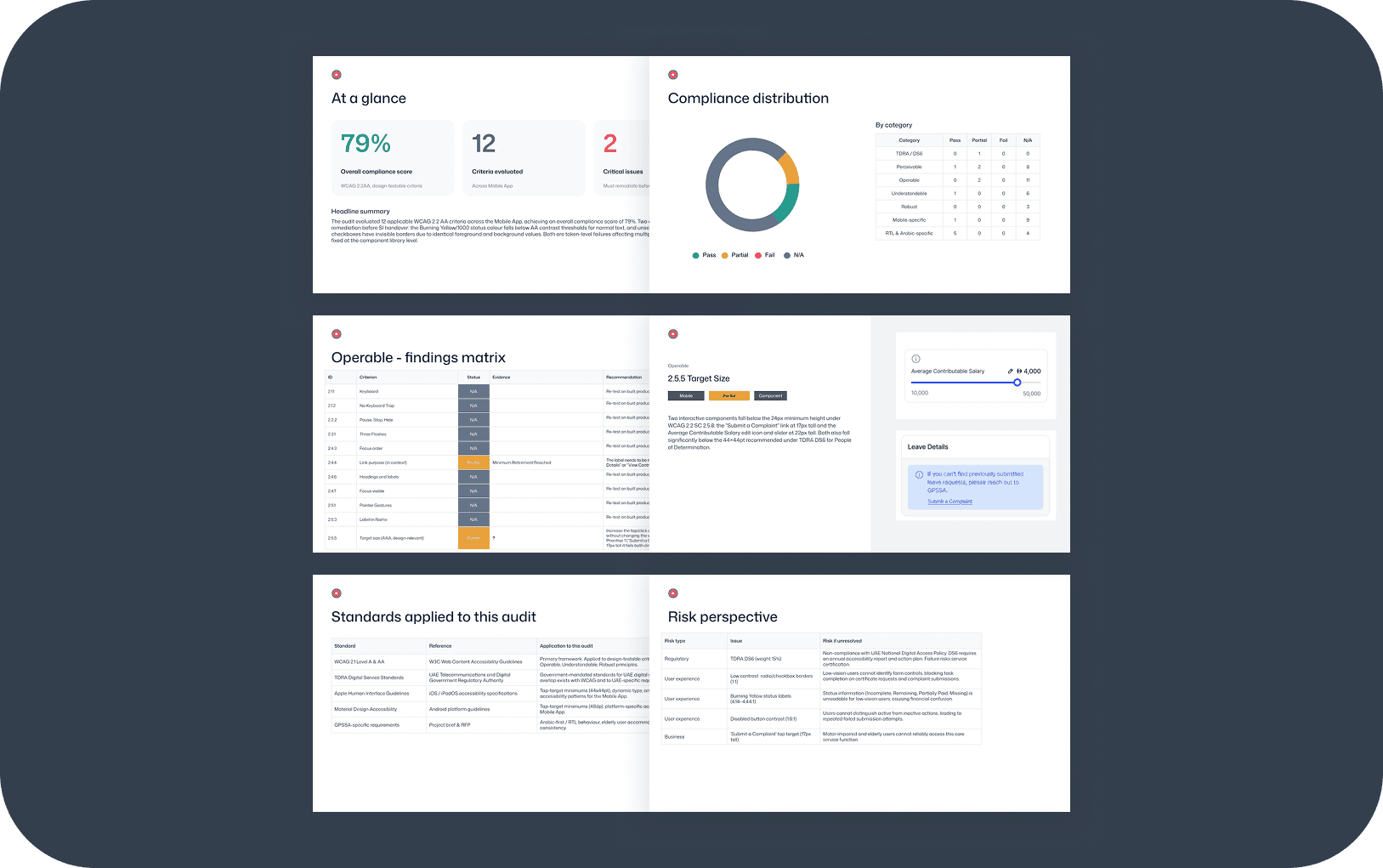
Finally I packaged it up: a client presentation (executive summary, stats, three themes, methodology, risk register and SI acceptance criteria).
Consistent findings
I gave every Partial or Fail the same four fields: Description, User Impact, Affected Components and Recommendation, so the report read consistently throughout. I flagged token-level fixes explicitly and two systemic token issues turned out to drive most of the critical failures.
Summary and handover
Finally I packaged it up: a client presentation (executive summary, stats, three themes, methodology, risk register and SI acceptance criteria).
KEY FINDINGS
KEY FINDINGS
13 criteria were applicable and tested. 7 passed, 5 were partial. The two most systemic issues were both token-level problems, meaning a single design system fix would resolve multiple failures across the product.
13 criteria were applicable and tested. 7 passed, 5 were partial. The two most systemic issues were both token-level problems, meaning a single design system fix would resolve multiple failures across the product.

IMPACT
IMPACT
This audit was commissioned to support SI handover but the value is broader than a compliance checklist. It documents a clear remediation path, protects against DS6 certification risk and gives the design team the specificity they need to fix things correctly.
This audit was commissioned to support SI handover but the value is broader than a compliance checklist. It documents a clear remediation path, protects against DS6 certification risk and gives the design team the specificity they need to fix things correctly.
FOOD FOR THOUGHT
FOOD FOR THOUGHT
Building the audit framework from scratch taught me that the foundations matter as much as the findings. A well-structured spreadsheet with clear status definitions and a transparent scoring formula meant the client could interrogate the results, not just read a verdict. When they came back with feedback asking to clarify the scoring methodology, I already had the formula documented, it just needed to be surfaced more clearly in the presentation.
Building the audit framework from scratch taught me that the foundations matter as much as the findings. A well-structured spreadsheet with clear status definitions and a transparent scoring formula meant the client could interrogate the results, not just read a verdict. When they came back with feedback asking to clarify the scoring methodology, I already had the formula documented, it just needed to be surfaced more clearly in the presentation.
Have a similar project?
Have a similar project?
Open to freelance projects across UK, UAE and US time zones. Fixed-project rates and day rates available. Scoping calls are free.
Copy email
Copy email
Designed in Figma, built in Framer.
Copyright 2026 Jayde-Olivia. All rights reserved.